
Science escape rooms and a live class quiz
Online escape rooms for every unit of CCEA GCSE and A-level Physics and Chemistry, a live scoreboard for your board, and Quiz Battle. Pupils join on their own devices with a game code; no accounts.
Pupils join at kredits.co.uk/join · laptops, tablets and phones
Four ways to play
The same questions, written to the CCEA specification, in four games.
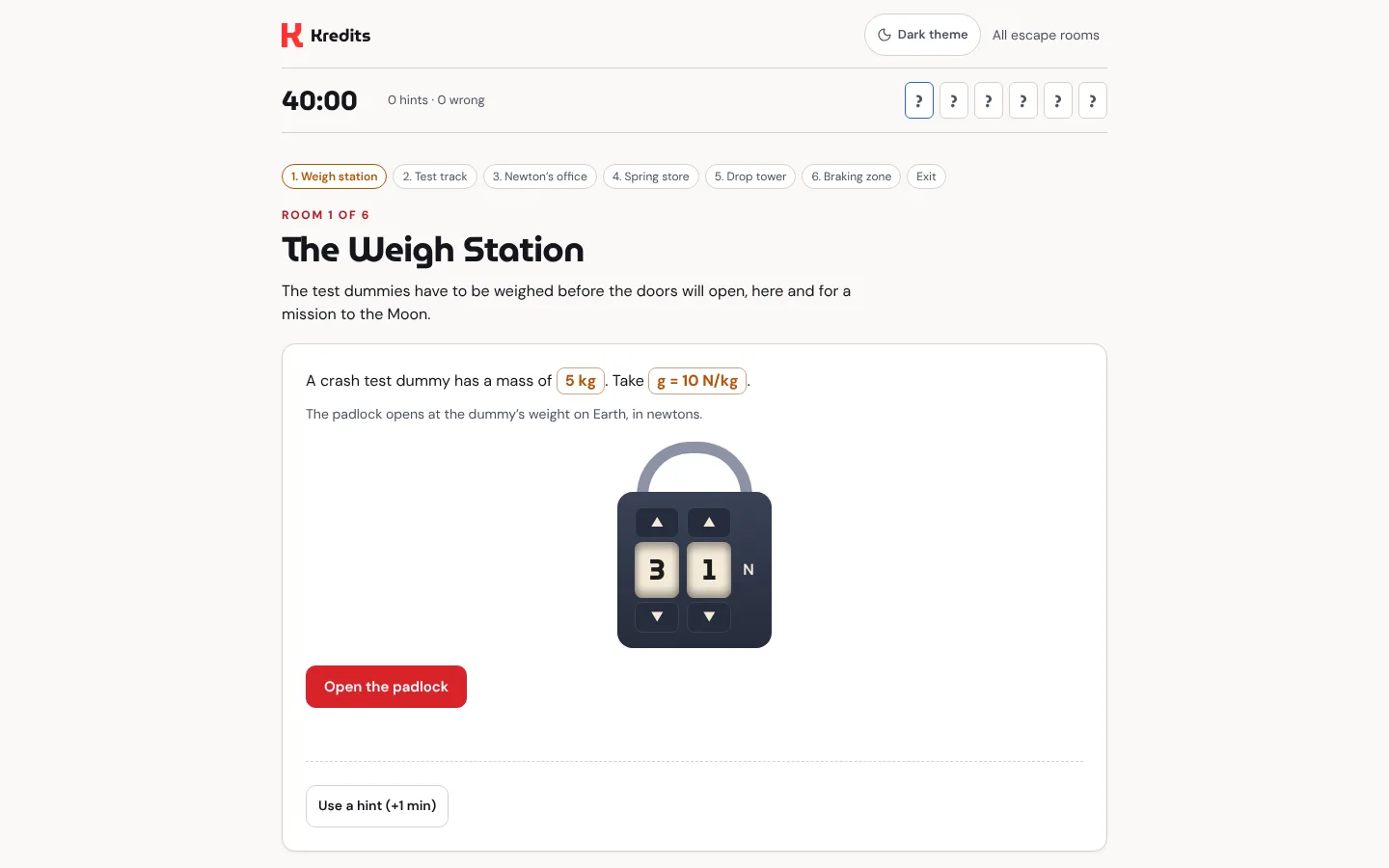
Escape rooms
53 rooms, one for every unit of CCEA GCSE and A-level Physics and Chemistry, plus a practice room. Solve each puzzle to open a lock and collect a digit of the exit code before the clock runs out. Play alone with nothing to sign in to. See all the rooms.
Escape room scoreboard
Put a live leaderboard on your board. Teams play a room on their own devices and every lock they open shows up as it happens. Hide the scores and reveal the places at the end.
Quiz Battle
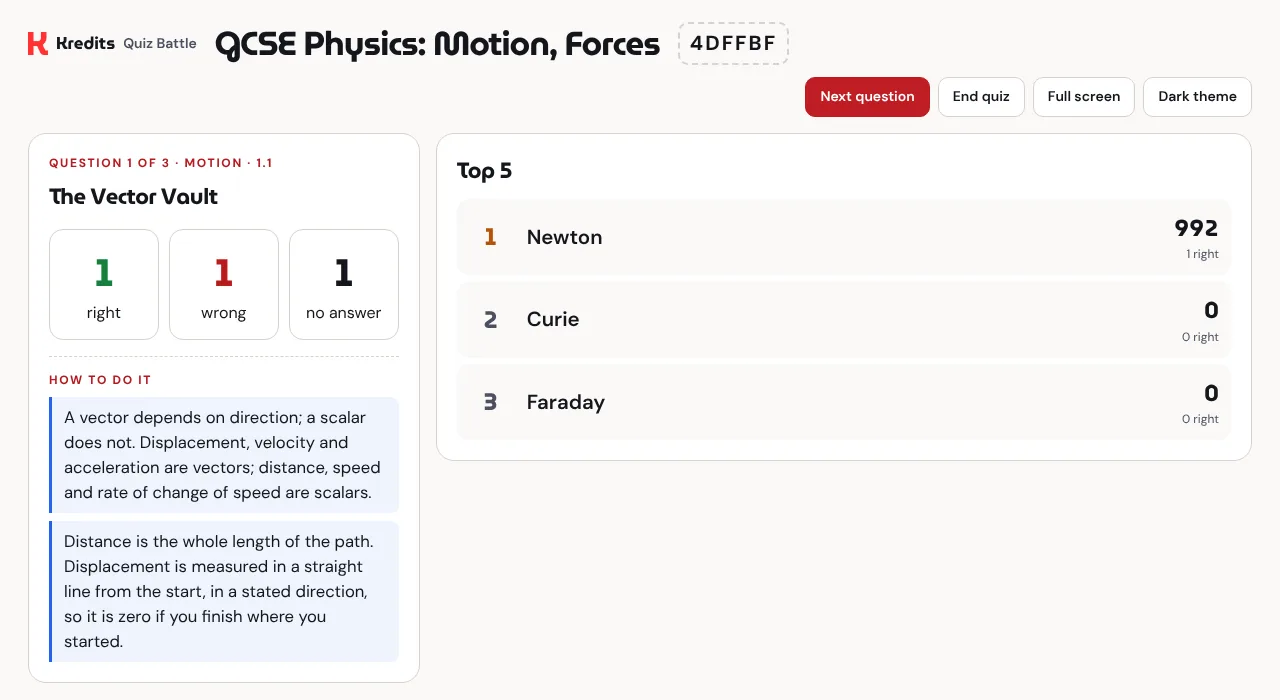
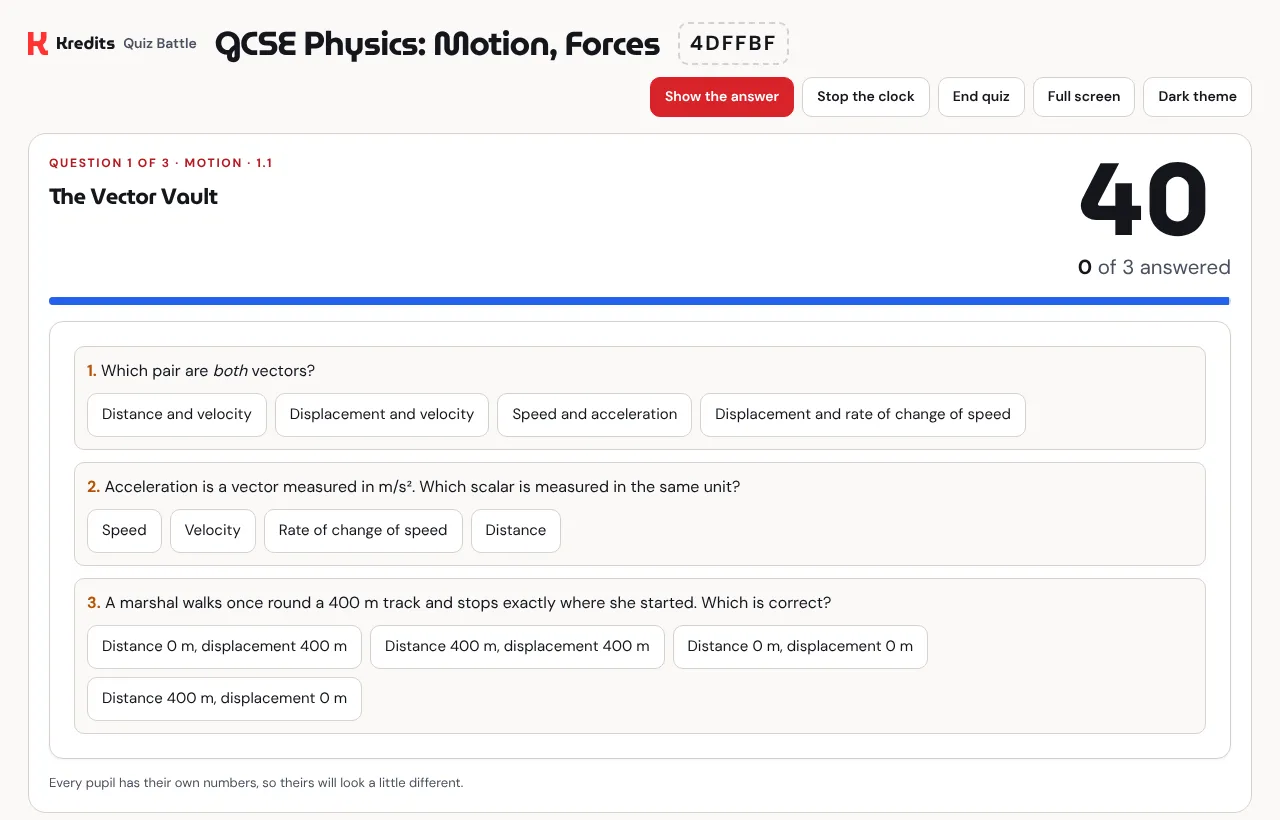
Pick rooms and the number of questions. Live: one question at a time on the clock, with the answer, the hints and the top five after each. Race: everyone at their own pace while the board shows progress.
Retrieval
A Do Now starter. Tick the topics you’ve taught and Kredits mixes 4 to 8 short questions from across them. Pupils answer in jotters, then reveal the answers one at a time with the working. Or send the same questions to their devices: no clock, no points, and the board shows how each question went. With Pro, each class’s topics are remembered, and Kredits Konfidence tracks how well the class and each pupil know every question, so the questions they need most come up first.
How it works
Pick a game
In Kredits, open Class Games. Choose an escape room, or tick rooms for a Quiz Battle.
Project the board
The board shows a six-character game code, e.g. K7P4QX, and a QR code.
Pupils join
They go to kredits.co.uk/join and type the code, or scan the QR code, then type a team name or nickname.
Quiz Battle: the same questions for everyone, one board
Every pupil answers exactly the same questions, with the same numbers, on their own device. Faster right answers score more.
After each question the board shows how many got it right, the “how to do it” hints for that question and the top five. You talk it through with the same question on screen.
Choose Double Award and the GCSE questions keep to the Double Award content.
Made for a real classroom
Pupils play on laptops, tablets or phones. Progress is saved in the browser, so a refreshed page carries on.
Wrong answers in an escape room cost 30 seconds and hints cost a minute, so teams think before they guess. The locks change from game to game: padlocks, wiring panels, memory cards, sorting and more.
With Kredits Pro, play an escape room with a class: Kredits makes the teams from your class list, and at the end you give each pupil Kredits points, as in Scoreboard.
A Quiz Battle with a class works the same way. Pupils tap their name (“Ada L.”) instead of typing a nickname, and a private teacher view on your own laptop, tablet or phone shows your seating plan, with each desk showing whether that pupil has answered and got it right. At the end Kredits suggests points (5, 4 and 3 for the top three, 1 for anyone with a right answer), which you can change before giving them.
Questions teachers ask
Are the escape rooms and Quiz Battle free?
Yes. Playing a room, running a live scoreboard and running a Quiz Battle are all free. Kredits Pro adds playing with a class: Kredits makes escape room teams from your class list, pupils pick their own name in a Quiz Battle, and you give Kredits points at the end.
Do pupils need an account?
No. Pupils go to kredits.co.uk/join and type the game code from your board, or scan the QR code. They type a team name or nickname, or in a class game pick their own name from a list; nothing else is asked for.
Which courses do the escape rooms cover?
CCEA GCSE Physics and GCSE Chemistry, and CCEA A-level Physics and A-level Chemistry: one room for every unit, 53 in all, plus a practice room for any class. Each room follows the CCEA specification.
Do the GCSE rooms suit Double Award?
Yes. Every GCSE Physics and GCSE Chemistry room has a Double Award mode that swaps out content that is only in the single-subject GCSE. Quiz Battle can use Double Award questions too.
Can pupils copy each other’s answers?
Not easily. The numbers in each question are made at random on each pupil’s device, so a neighbour’s answer is usually wrong for you, and many locks change from game to game.
What information is kept about pupils?
Only the team name or nickname they type and how they are getting on: locks opened, right answers, time taken and points. There is no pupil account, email address or device identifier. Apart from the top five names shown on a Quiz Battle board, and in a class quiz the list of first names and surname initials pupils pick from, only the teacher who set the game up can see the results. See Privacy Policy section 3b.
More free Kredits tools
Set up a class once and use it in every tool.